Pick a Buyer - it's Reverse Real Estate
What is reverse real estate?
Buyers post what you want.
Sellers come to them.
Free while you're buying.
Free to add your home and see who matches.
Buyer I want a 4 bedroom house with a pool in The Gap
Buyer I want a 3 bedroom near transport, ready to move
Buyer I want a Queenslander close to the city
How it works
Three simple steps to reverse real estate.
-
Pick your suburbs. Set the budget. Three bedrooms and two bathrooms, must-have. Pool, definitely. Solar would be nice. Tag everything must-have, important, or nice-to-have. Five minutes, and free forever.
-
Add your home and search. Every matching buyer appears, ranked 0–100 against your property, feature by feature, weighted to what each of them said matters most. Seeing the list costs nothing.
-
First names only, and only what each of you chooses to share. Free-form chat, or a structured (non-binding) offer negotiation with a full audit trail. We stay out of the way.
You stay anonymous the whole way. First names only, and nothing reaches anyone else unless you choose to reply.
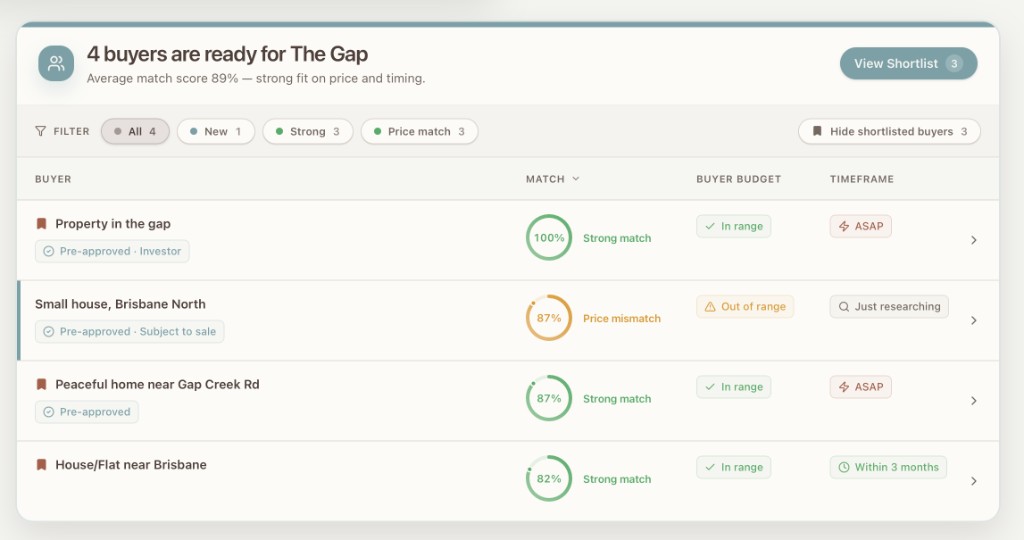
Rankings are an automated comparison of the criteria each buyer entered — not a recommendation or an assessment by Pick a Buyer.
Why real estate is still stuck in the past
If real estate were invented today, it would look different.
-
Why do buyers lose every weekend to open homes?
They shouldn't have to.
With Pick a Buyer, you post what you want once — the suburbs, the budget, the things you will not compromise on. Then let sellers bring you the homes that match it.
-
Why do sellers open their front door to people who were never going to buy?
They shouldn't have to.
Buyers have already posted what they are after. In Pick a Buyer, search that list, and spend your time on the ones whose requirements your home actually meets.
-
Why does selling a house cost you $20,000 or more?
It shouldn't.
With Pick a Buyer, it's $49 a month — whatever your house is worth.
Here's how life has changed
"Because that's how it's always been done."
That's not a reason.
Figures are rounded and illustrative, not a quote. Commission rates vary by state, agency and property, and the current figure is before GST, which did not exist in 1995. Pick a Buyer does not replace your agent — plenty of people run both at once — and using it does not by itself avoid an agent's commission.
Sources and how these figures are worked out
Queensland capped agent commissions until 1 December 2014 at 5% of the first $18,000 of the sale price plus 2.5% of the balance (Property Agents and Motor Dealers Regulation 2001, sch 1A, carrying forward the scale set by the Auctioneers and Agents Regulations 1986). On the 1995 price that is $3,625, and most agents charged the maximum. The Property Occupations Act 2014 removed the cap, and Queensland was the only state that had one. There is no statutory ceiling today; 2–2.5% is the typical Australian range (source: realestate.com.au), so $27,800 is 2.5% of the current figure, and many sellers pay more once listing and marketing fees are added. The 1995 price is the average median house price across the eight capital cities that year (source: Abelson & Chung long-run series); the current figure is the mean price of all residential dwellings nationally as at the March 2026 quarter (source: Australian Bureau of Statistics). These are different measures — a transaction median for capital-city houses against a stock mean for all dwellings — so the comparison indicates the scale of the change rather than a like-for-like figure. The two commission figures are worked out differently because the rules were: the 1995 one is the capped scale applied to that price, the current one is 2.5% of the current price. The "$20,000 or more" above is the low end of the same sum — 2% of the current figure is $22,200.
Price
No percentage of your sale.
Already have an agent? Use both. Pick a Buyer doesn't replace your agent, and you don't have to commit to either on day one.
Buyers
Free
Always. Not a free tier, not a free trial — buyers never pay us.
Sellers
$49a month
Adding your property and seeing your matching buyers is free. The subscription gives you access to the full platform features — shortlist buyers, contact them, and respond to offers. Month to month, cancel anytime.
Ready to try reverse real estate?
One account.
Tell sellers what you're looking for.
Search for buyers who are looking for a place just like yours.
Or do both at the same time.
Free to join. No card required.